A daily memorial · data journalism & generative art · 2024
Every day the news reported them. Every day, this work remembered them.
The work
For six months in 2024, an automated system searched the news of some twenty-five countries, in their own languages, for reports of femicide.
Each verified-relevant report became a work: fifteen objects drawn from the article; a symbolic image built from those objects; a poem composed in the language of the report; and a link back to the source. About a hundred cases a day. The daily system has since become an archive. It is released under a Creative Commons license.
~25 countries · ~100 cases a day · 11,000+ images and poems in six months · poems in the language of each report
The project publishes its own process — the search, the collection, the automated reading that pulls each case's objects, the image and the poem — and each work carries its metadata and a link to the report it came from.
Relevance was assessed automatically; the project does not claim every report was independently verified.
One work, held
Not a gallery — one work, held still. A single case from the archive, as the machine composed it.
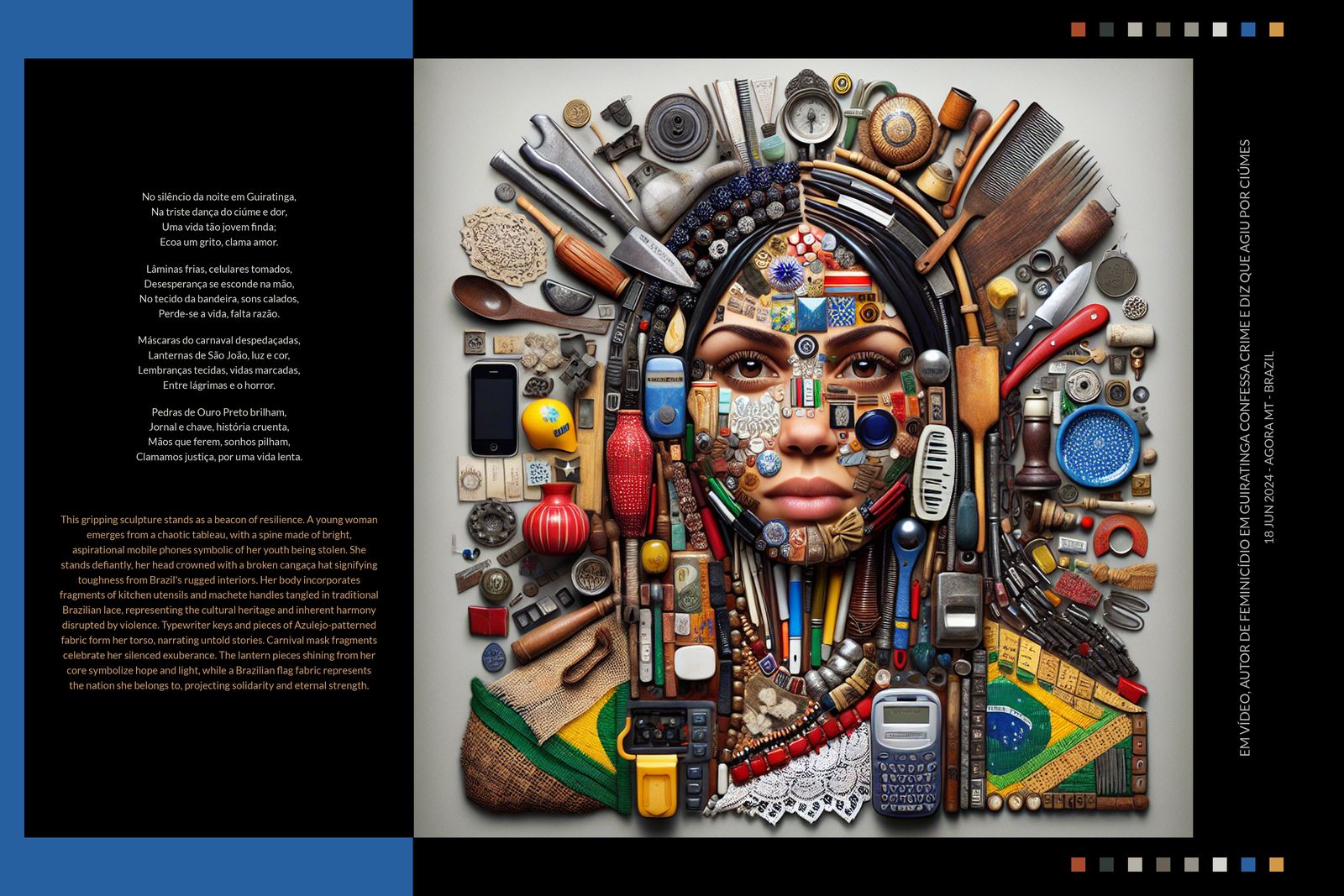
Its images are symbolic compositions, never portraits of victims. Here a face is built from the objects of a life — utensils and lace, a knife, a phone, keys, a flag — and a poem is written beside it, in the language of the report.
Guiratinga, Mato Grosso, Brazil · 18 June 2024 · from a report by Agora MT
One work, complete — the sculpture, its objects, its poem, its date. The archive holds more than eleven thousand.
The scale
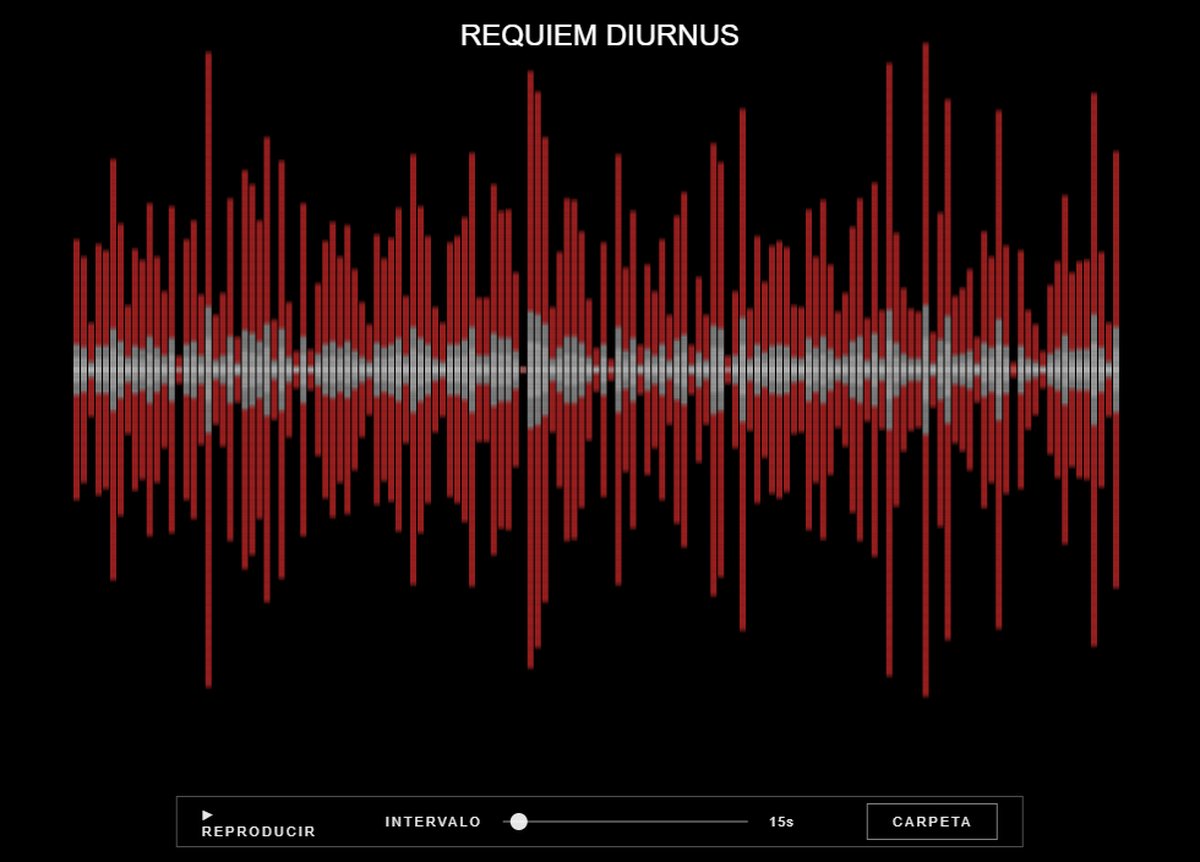
A requiem is sung once. This one ran daily, because the violence is daily — one day's news alone could carry two hundred reports. The archive holds the six months as a red histogram, a waveform of days, and the works are reached through it.
The archive's own interface — six months of days; the red bars are the count.
The prologue
Brenda Romero's prologue to the work opens with Frida Kahlo's Unos cuantos piquetitos (1935) — painted after a newspaper minimized a murder — and places Requiem Diurnus in that lineage: art answering journalistic language that minimizes violence against women. The prologue reads the work as a global memorial and a refusal of sensationalism, its passage from news to image and poem a kind of intersemiotic translation. Read the prologue →
In the scholarly record
Claudia Kozak — a conference paper at Roma Tre (2024) and a later journal article read the work as a test of whether Latin American digital art can turn the dominant AI systems against themselves: a decolonial archive built with the very platforms of data colonialism, working with and against its tools. Kozak also names its limit — the image model keeps reproducing stylized, narrow-waisted female forms; the bias survives the intervention.
Maria Elisa Rodrigues Moreira — a peer-reviewed article devoted to the work, "O requiem diurnus de Diego Bonilla: morte e materialidade em conjunção" (Texto Digital, 2025; online January 2026), reads it through Vilém Flusser's technical images and the materiality of objects generated from language. Moreira argues that the project reasserts the victims' subjectivity — her interpretation, offered as a reading, not a measured outcome.
Exhibited — the central work of the Sacramento State Library exhibition Femicides: Shattering the Silence of Violence Against Women, within Chicanx/Latinx Excellence at Sac State and Beyond, curated by Bonilla with Brenda Romero and Maria Vargas.
The archive
The daily run has ended; the archive remains, every work linked to the report it remembers.
Credits
Diego Bonilla — concept, programming, direction.
Brenda Romero — prologue.
Exhibited at the Sacramento State Library, co-curated with Brenda Romero and Maria Vargas.