Photographic VR of ancient Pompeii · 2002 — 2020
A ruined city photographed vantage by vantage — a place to walk, before the headset existed.
The work
In 2002 the author photographed the archaeological site of ancient Pompeii — its streets, houses, theaters and baths — thousands of photographs taken vantage by vantage.
Those photographs were stitched into 360° cylindrical panoramas and linked together in QuickTime VR. On a 2003 desktop the ruined city became a place you could stand inside and pan around, moving vantage to vantage down a street or through a house — an immersive documentation of a real place, and the earliest of the author's works in the immersive line, two decades before the headset.
3,769 source photographs · 1,648 processed images · 534 stitched panoramas · quicktime vr
The vantages
Each panorama is one place to stand. Four of the hundreds are below — drag them to pan, the way the QuickTime-VR panoramas panned on the screen. Named where the archive names them.
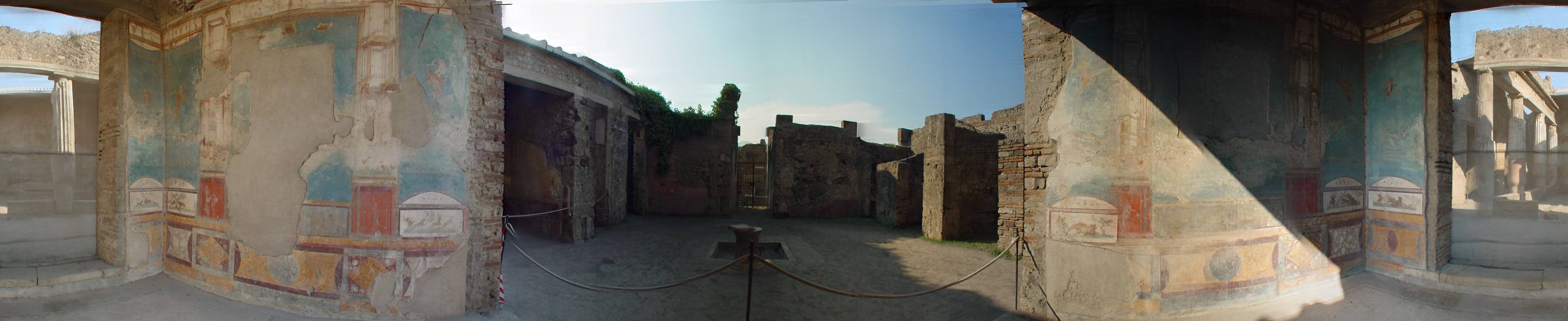
Casa della Caccia Antica — the House of the Ancient Hunt, its frescoed walls in afternoon light. Drag to pan.

The Forum. Drag to pan.

A street of the city — the shoot moved down the streets vantage by vantage. Drag to pan.
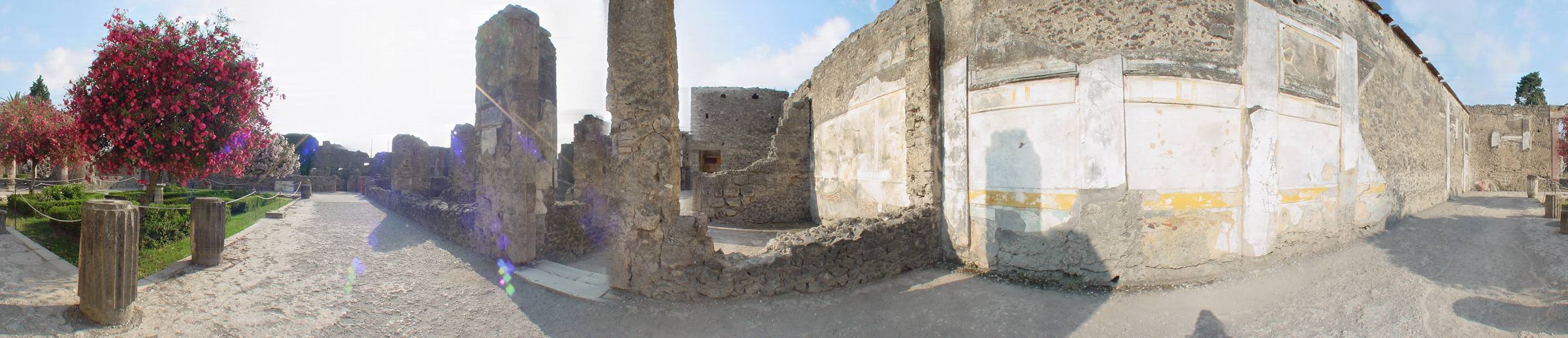
Casa del Fauno — the House of the Faun. Drag to pan.
Eighteen years
The shoot and the first builds came in 2002–2003, under the working name Quartio. Across the 2000s the navigable city was rebuilt in iteration after iteration; a panorama-processing pass in 2006 produced the stitched vantages the archive still holds. And in 2020 an 8K VR-video version was extracted from the original photography — a re-extraction of the 2003 imagery, not a new shoot: the work returning to itself one more time, eighteen years on.
The 8K version is not shown here; this page stands on the original 2002–2003 photography.
Provenance
In 2003 the work was presented as "Virtual Tour of Pompeii," a collaboration between Bonilla and Francesca Tronchin — art historian and classical archaeologist — at Pompeii, Italy, in connection with the exhibition "A Day in Pompeii" at the Melbourne Museum in Australia. The virtual city was shown at the real one.
In the record
The work is cited in an independent scholarly article — "Digital Spaces: Pompeii, the Internet and Beyond," Archeologia e Calcolatori 15, 449–464 (2004) — an early register of Pompeii's life on the internet. Read it on Academia →
Credits
Diego Bonilla — photography, programming, direction.
Francesca Tronchin — collaborator; the 2003 presentation "Virtual Tour of Pompeii" was Bonilla & Tronchin.