Net-art & hypermedia environment · 1995–2001

Hypergraphia  n.

1.Medicine. The compulsion to write.
2.Bonilla, 1995—. Almost the word hypertext — but given "a unique definition in relation to my work": an idea about the non-linear possibilities of the new technologies within a multimedia environment, beyond the mere transmission of text with links.— the definition on the site's own front page, 1997.

The word this site is named after.
The site

More than 160 electronic pages

A sprawling environment on the Netscape-era web — poems, newspaper columns, a literary magazine, a photographic exhibition — built from hand-made GIFs, HTML, and Shockwave, when 28.8 kbps was the recommended minimum. Poetry you navigated, years before the tools had names for it.

160+ pages  ·  GIF, HTML & Shockwave  ·  Netscape era  ·  28.8 kbps minimum recommended

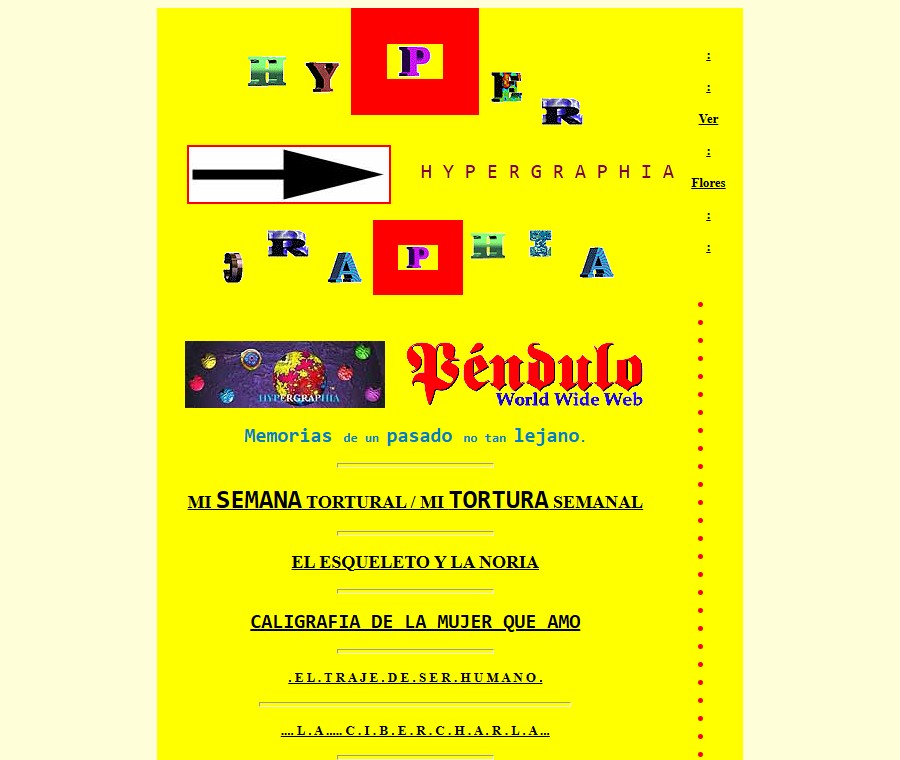
The Hypergraphia entry page of 1997: textured GIF letters spelling HYPERGRAPHIA, a black dominant arrow, the Péndulo World Wide Web banner, and a list of poem-pieces, all on a chrome-yellow ground.

The entry hall, as preserved — the server copy of May 1997. It still renders in a browser today.

The branches

Two pieces, as preserved

The navigation map sorted the pages into branches — subramas. Two of them.

La Noria Digital

"The Digital Ferris Wheel"

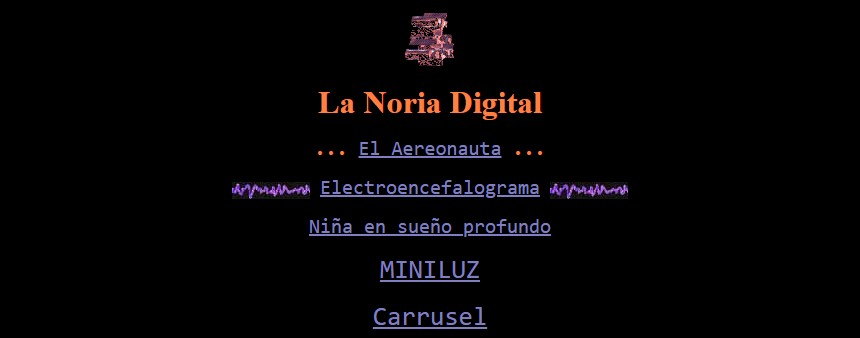
Net-art poetry on black — El Aereonauta, Electroencefalograma, Niña en sueño profundo, Miniluz, Carrusel. Titles you clicked into, each its own small world.

La Noria Digital: orange and blue links on black listing the poem-pieces El Aereonauta, Electroencefalograma, Niña en sueño profundo, Miniluz, Carrusel.

Mi Semana Tortural / Mi Tortura Semanal

A wordplay: "my tortural week / my weekly torture"

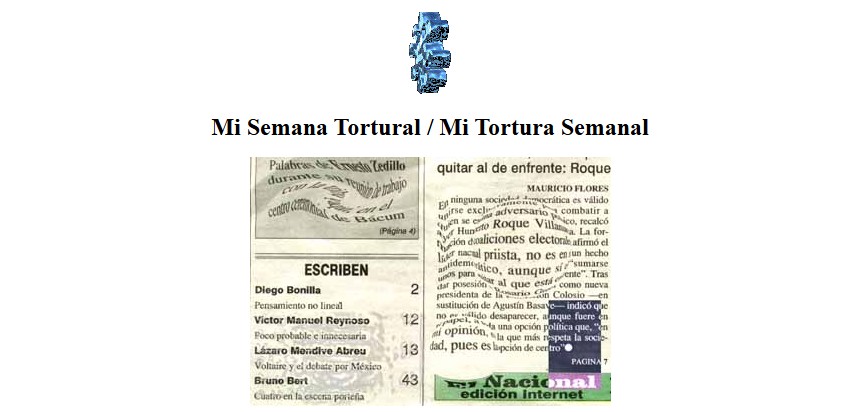
The Saturday columns Bonilla wrote for the Mexico City newspaper El Nacional, gathered into the artwork — the career's journalistic origin, preserved inside the poetry.

Mi Semana Tortural: a scanned clipping from El Nacional's internet edition beside an introduction, above a list of column titles.

The magazine inside the site

Péndulo, on the web since March 1995

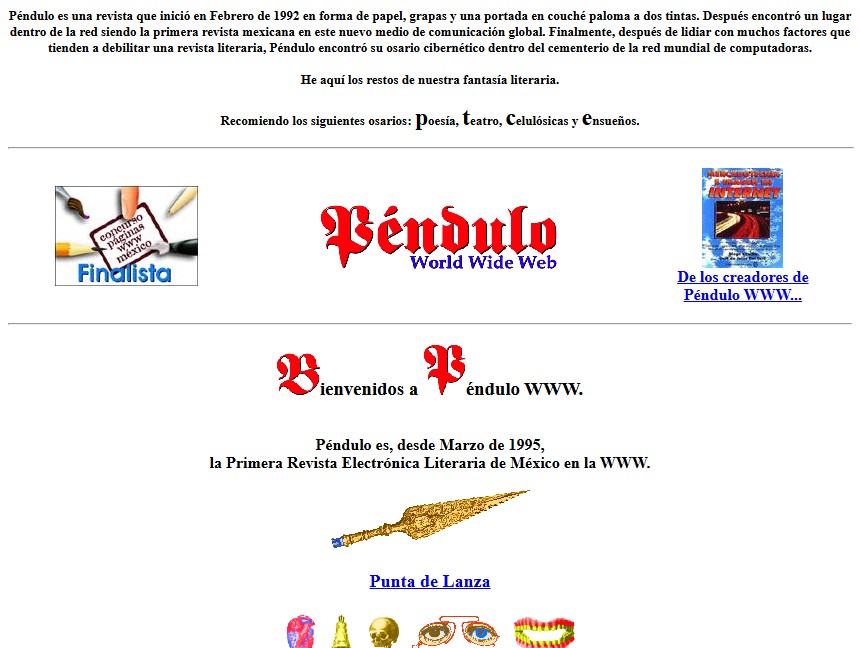
Born on paper in February 1992 — staples and a two-ink couché cover — the poetry magazine Péndulo moved onto the young web and became, in its own words on the page, "desde Marzo de 1995, la Primera Revista Electrónica Literaria de México en la WWW" — the first Mexican electronic literary magazine on the web. Poesía · Narrativa · Teatro · Entrevista · Ensayo · Celulósicas · La Plástica · Ensueños. This is where the site's "since 1995" begins.

The Péndulo World Wide Web welcome screen: a gothic red Péndulo wordmark, a spear graphic titled Punta de Lanza, a row of small icons, and the section links.

The name at work

The name before the net-art

Before it was net-art, Hypergraphia was also a company — among the earliest internet ventures in Mexico, in the mid-1990s — and the name carried both lives at once. Its earlier identity survives on the site under the heading "Lo que era antes Hypergraphia…": a jeweled-sphere trademark banner.

The HYPERGRAPHIA trademark banner: jeweled fractal spheres floating on a purple ground, the word HYPERGRAPHIA below.

From its founders came a printed book on the young commercial web — Mercadotecnia e Imagen en Internet, by Diego Bonilla and José de Jesús Del Toro, the poet who returns, fifteen years later, as the writer of Liber Rotavi.

Found online, 1999

What it became

In 1999 the poet and scholar Rodolfo Mata, of UNAM, came across Hypergraphia online — the beginning of a collaboration that runs through Poesía Densa (2003) to the Tablada hipertextual (2020). Del Toro, co-author of the venture's book, returns as the poet of Liber Rotavi (2012). And the name itself never stopped: the domain, the practice, and this thirty-year retrospective all kept it.

Its most direct descendant is the site you are reading.

The artifact

What remains

The Shockwave and PowerPoint pieces sleep — their players are gone — but the HTML and GIF pages still render in a modern browser, unchanged. The archive holds dated copies of the server across the years; the time-series is itself an artifact.

Server copiesMay 1997 · Feb 1998 · Jul 1999 · Aug 1999 · Dec 1999 · Dec 2001
Rendered from"copia de lo que hay en el servidor a mayo de 1997"

The original Director sources — including a piece named "random Text interface" — are preserved. A native re-creation is a project for another time.

Credits

Diego Bonilla — concept, design, writing, programming · 1995–2001.

With the online magazine Péndulo, and José de Jesús Del Toro (co-author of the venture's book).